

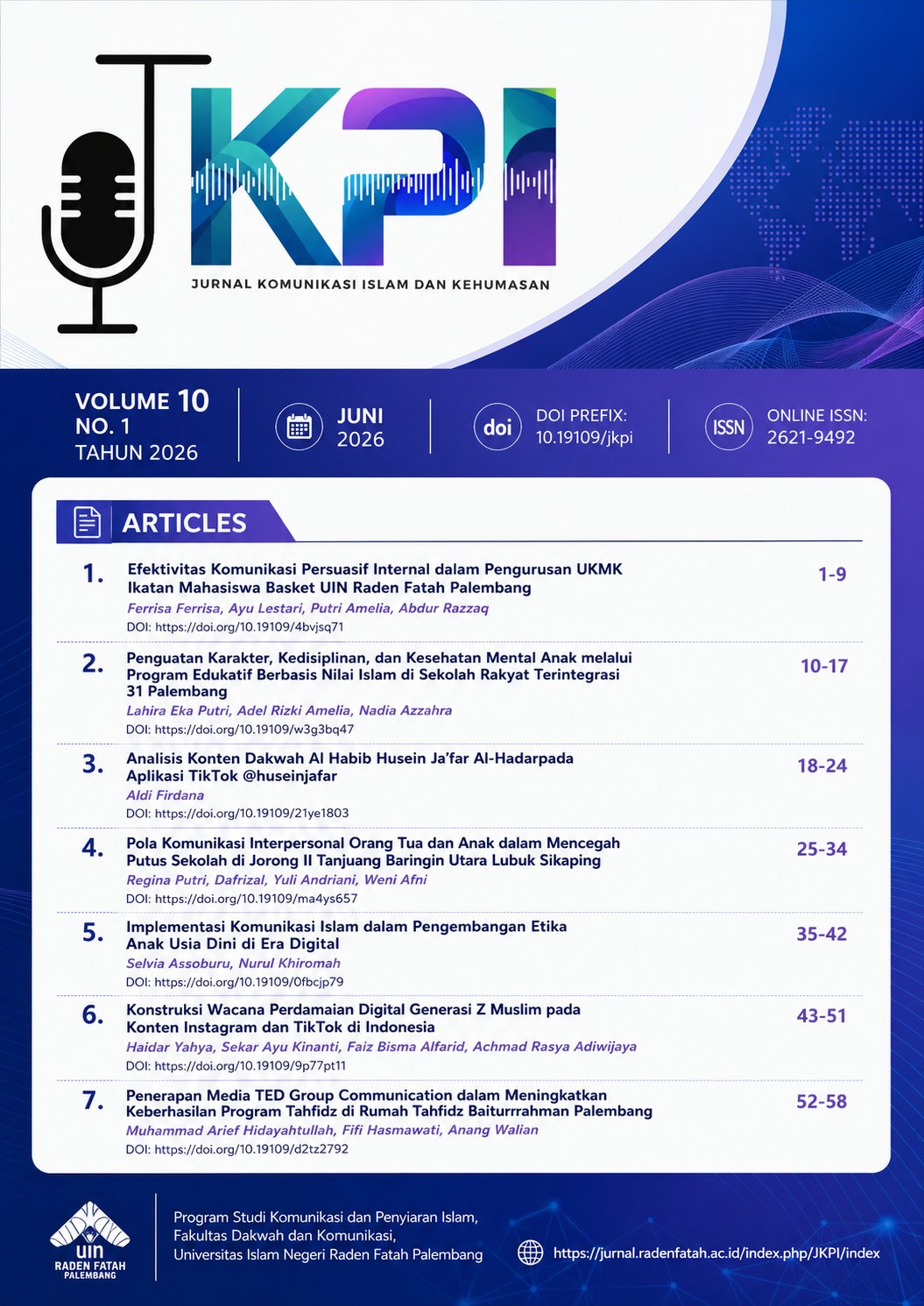
Implementasi Komunikasi Islam dalam Pengembangan Etika Anak Usia Dini di Era Digital
Article Sidebar
Main Article Content
Abstract
This article examines the implementation of Islamic communication in developing early childhood ethics in the digital era. It applies library research and content analysis to Qur'anic verses on qawlan principles, hadith on ethical speech, and scholarly literature on Islamic family education, digital literacy, and child development. The discussion focuses on six principles of Islamic communication: qawlan sadidan, qawlan kariman, qawlan ma'rufan, qawlan layyinan, qawlan maysuran, and qawlan balighan. The synthesis shows that these principles can function as a pedagogical framework for fostering honesty, politeness, responsibility, empathy, self-control, and ethical digital conduct. Islamic communication should not be reduced to verbal advice. It must be practiced through language modeling, content mediation, screen-time rules, value reflection, and evaluation of children's digital behavior. This study highlights the need for collaboration between families and educators to build children's digital ethics in line with Islamic values
Downloads
Article Details
Section

This work is licensed under a Creative Commons Attribution-ShareAlike 4.0 International License.