
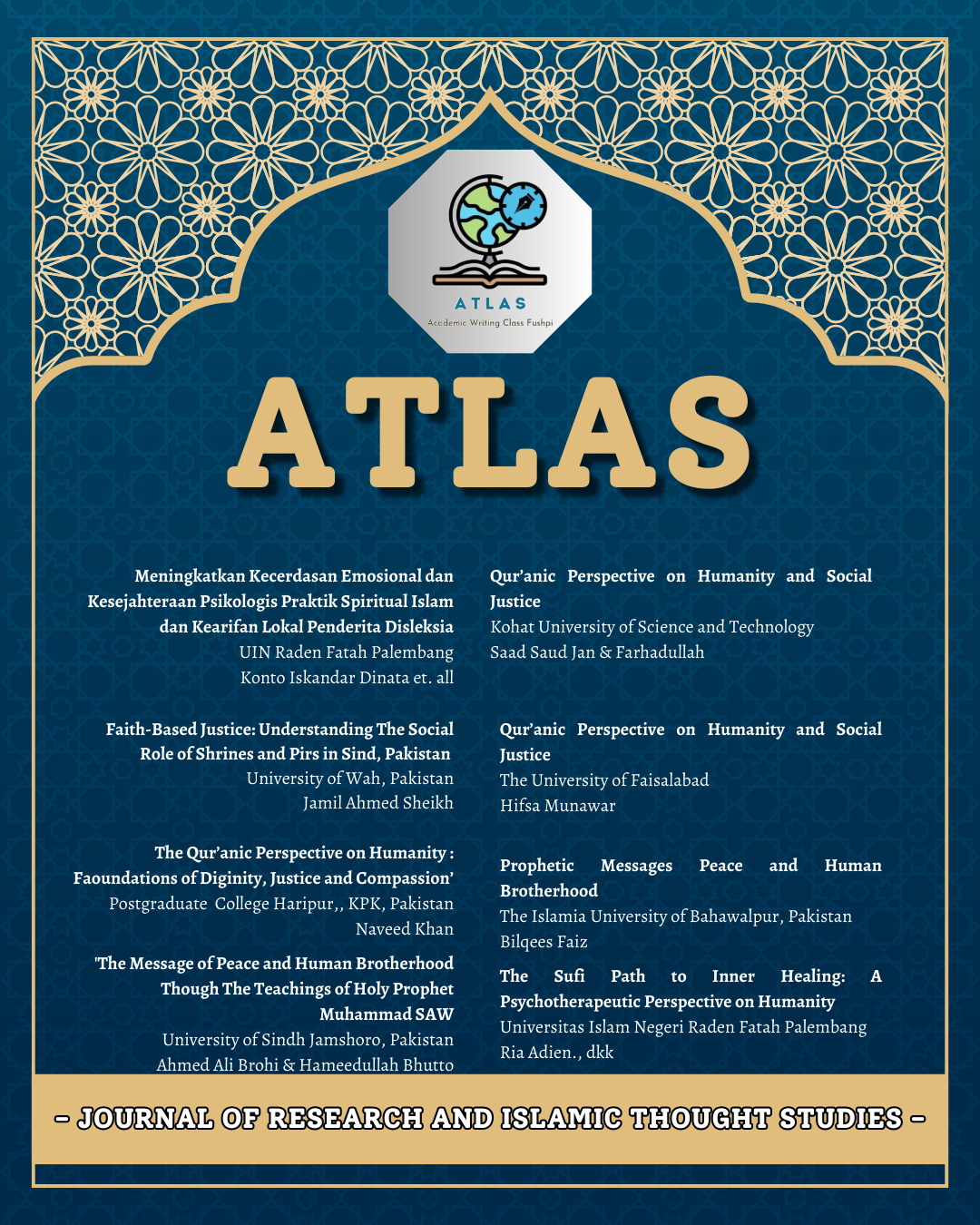
The Qur’anic Perspective On Humanity : Foundations Of Dignity, Justice, And Compassion
Article Sidebar
Main Article Content
Abstract
The Qur’an articulates a universal and comprehensive vision of humanity rooted in the divine principles of dignity (karāmah), justice (‘adl), and compassion (raḥmah). It envisions every human being as a bearer of divine trust (amānah) and moral accountability, transcending all barriers of race, ethnicity, religion, and geography. This paper explores how the Qur’anic conception of the human being forms a holistic moral framework that upholds equality, justice, and compassion as inseparable dimensions of human existence. Through an interpretive analysis of key Qur’anic themes such as the innate honor granted to humanity, the moral responsibility entrusted to human beings as God’s vicegerents on earth, and the divine command to establish justice the study demonstrates that human worth in Islam is intrinsic rather than acquired, and moral responsibility is universal rather than selective.Employing a qualitative-descriptive methodology based on thematic exegesis (tafsīr mawḍūʿī) and comparative analysis of classical and contemporary Qur’anic commentaries, the research investigates how these teachings provide an ethical response to modern moral challenges, including social inequality, racial discrimination, and the erosion of compassion in global societies. The paper argues that the Qur’an does not merely propose a theological doctrine of faith but offers a coherent and dynamic moral philosophy one that integrates spirituality with social ethics, and divine revelation with human responsibility. Ultimately, the study concludes that the Qur’anic vision represents a timeless charter for human dignity and global harmony, capable of guiding contemporary humanity toward peace, justice, and moral balance.
Article Details

This work is licensed under a Creative Commons Attribution-ShareAlike 4.0 International License.
References
Al-Ṭabarī, Muhammad ibn Jarīr. Tafsīr al-Ṭabarī. (2001). Vol. 15. Beirut: Dār al-Kutub al-‘Ilmiyyah.
Al-Rāzī, Fakhr al-Dīn. (2000). Tafsīr al-Kabīr. Vol. 20. Beirut: Dār al-Kutub al-‘Ilmiyyah.
An-Na’im, Abdullahi. (2008). Islam and the Secular State. Harvard University Press.
Engineer, Asghar Ali. (1990). Islam and Liberation Theology. New York: Sterling Publishers.
Fazlur Rahman. (2009). Major Themes of the Qur’an, Chicago: University of Chicago Press.
Hanbal, Ahmad ibn. (1998). Musnad Ahmad, Vol. 2. Beirut: Dār al-Fikr.
Ibn Kathīr, Ismā‘īl ibn ‘Umar. (1999). Tafsīr Ibn Kathīr. Vol. 1. Cairo: Dār al-Hadīth.
Iqbal, Muhammad. (1934). The Reconstruction of Religious Thought in Islam. Lahore: Iqbal Academy.
Kamali, M. H.(2002). The Dignity of Man: An Islamic Perspective. Cambridge: Islamic Texts Society.
Nasr, Seyyed Hossein. (2015). The Study Quran. New York: HarperOne.
Rahman, Fazlur. (2009). Major Themes of the Qur’an. Chicago: University of Chicago Press.