
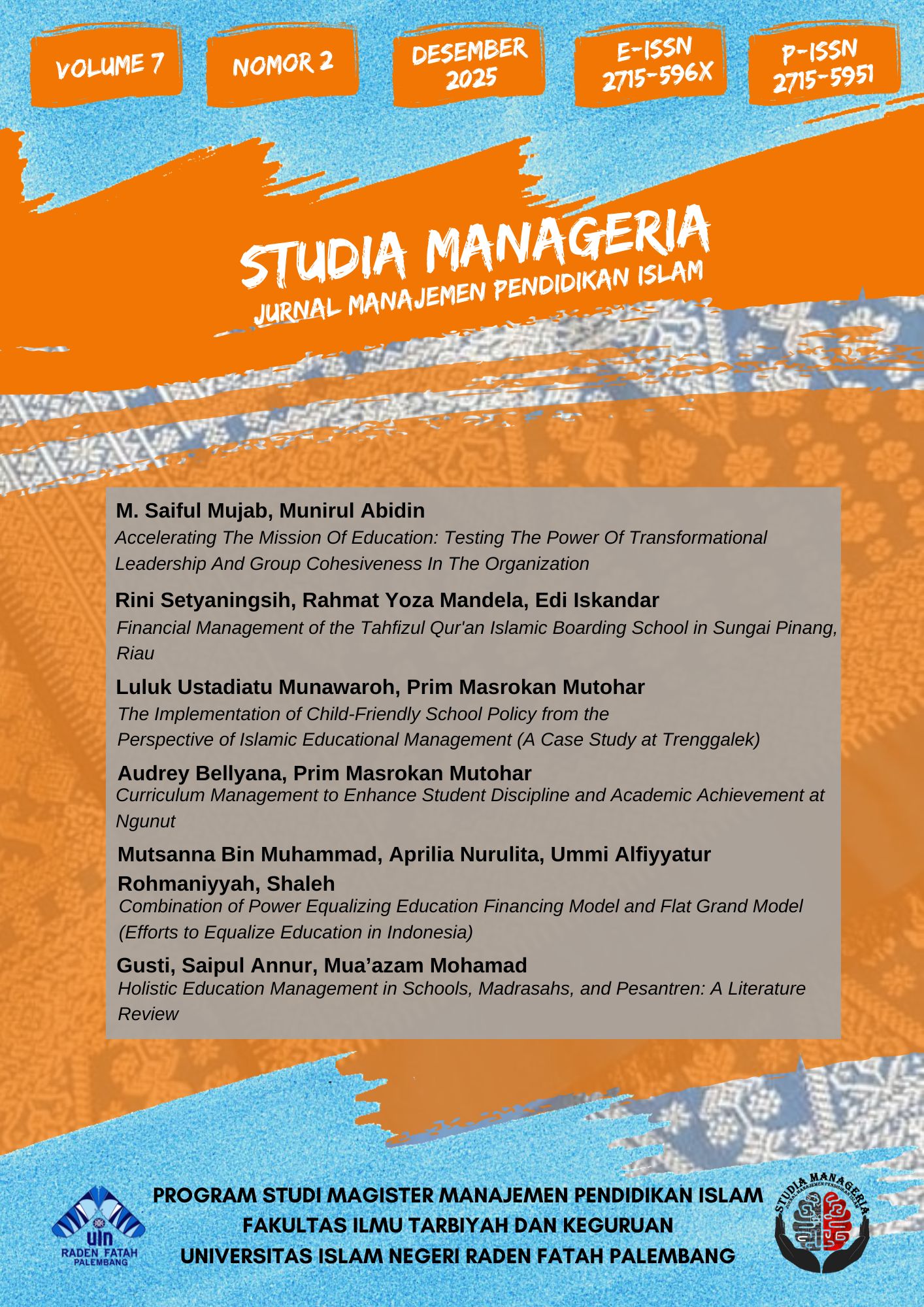
Accelerating The Mission Of Education: Testing The Power Of Transformational Leadership And Group Cohesiveness In The Organization
Article Sidebar
Main Article Content
Abstract
Achieving the mission of educational institutions is a crucial factor in the progress of education in Indonesia. Researchers often encounter obstacles in mission achievement due to leadership deficiencies, poor human resource quality, and insufficient support from surrounding groups. Therefore, this research aims to determine the influence of transformational leadership and human resource quality on mission achievement, moderated by group cohesiveness. This study employs a quantitative method, with data collected via Google Form questionnaires, which were distributed through WhatsApp and analyzed using SmartPLS 4. The results indicate that transformational leadership and group cohesiveness have a significant effect on the effectiveness of mission achievement in educational institutions, whereas other variables showed no significant effect. The implications of this research suggest that to enhance mission achievement effectiveness, educational institutions must prioritize the development of transformational leadership character and build a solid and cohesive work climate. This implies that institutional success depends more on the leader's vision and team cohesion than merely on staff qualifications.
Article Details

This work is licensed under a Creative Commons Attribution-ShareAlike 4.0 International License.

Studia Manageria by http://jurnal.radenfatah.ac.id/index.php/studiamanageria is licensed under a Creative Commons Attribution-ShareAlike 4.0 International License.
How to Cite
References
Ahmad, D. Z. S., Muqopie, A., Zohriah, & Anis. (2023). Gaya Kepemimpinan dalam Lembaga Pendidikan. Journal on Education, 6(1), 5218–5223. Retrieved from https://www.jonedu.org/index.php/joe/article/view/3665
Bismoko, A. B., Kristiawan, M., & Fitria, H. (2023). Kepemimpinan Transformasional di Era Digital dalam Organisasi Pendidikan. Jurnal Manajemen Pendidikan, 11(2). Retrieved from https://ejournal.unesa.ac.id/index.php/jmp/article/view/52341
Cabrera, E. F., & Cabrera, A. (2002). Knowledge-sharing dilemmas. Organization Studies. Organization Studies, 23(5), 687–710. https://doi.org/10.1177/0170840602235001
Caharian, I., & Cabanlit, E. (2024). Tinjauan sistematis tentang pengaruh kepemimpinan transformasional dan komitmen guru terhadap lembaga pendidikan. Urnal Internasional Penelitian Dan Inovasi Dalam Ilmu Sosial, 8(9), 65–78.
Gao, L., Hamid, A., & Mansor, A. (2024). Peran kepemimpinan transformasional dalam komunitas pembelajaran profesional: Bukti empiris dari Tiongkok. Jurnal Penelitian Pedagogis, 8(3), 263–278.
Gully, S. M., Incalcaterra, K. A., Joshi, A., & Beaubien, J. M. (2002). A meta-analysis of team-efficacy, potency, and performance: Interdependence and level of analysis as moderators of relationships. Journal of Applied Psychology, 87(5), 819–832. https://doi.org/10.1037/0021-9010.87.5.819
Hair, J. F., Hult, G. T. M., Ringle, C. M., & Sarstedt, M. (2021). A Primer on Partial Least Squares Structural Equation Modeling (PLS-SEM. Sage Publications. https://doi.org/10.1007/978-3-030-80171-7
Limon, I., & Dilekçi, Ü. (2022). The Relationship Between Transformational Leadership and Organizational Commitment: A Meta-Analysis. International Journal of Contemporary Educational Research, 7(2), 1–10. https://doi.org/10.33200/ijcer.751343
Masaong, A. K., Aneta, A., & Masaong, A. (2023). Kepemimpinan Transformasional Kepala Sekolah dalam Meningkatkan Mutu Pendidikan di Era Merdeka Belajar. Jurnal Akuntabilitas Manajemen Pendidikan, 11(1), 1–12. https://doi.org/10.21831/jamp.v11i1.56421
Mustofa, A., Setyadji, B., & Sunaryo, H. (2021). Human Resource Quality and Its Impact on Educational Effectiveness: A Quantitative Study. Journal of Educational Management, 9(3), 1–14. Retrieved from https://journal.unnes.ac.id/sju/index.php/eduman/article/view/45672
Nasukah, B., & Maunah, B. (2021). Kepemimpinan Transformasional Dalam Tinjauan Sejarah Dan Perkembangan Kajiannya Pada Bidang Pendidikan. Jurnal Kepemimpinan Dan Pengurusan Sekolah, 6(1), 38–48. https://doi.org/10.34125/kp.v6i1.589
Pradana, A., & Rahardjo, S. (2022). Group Cohesiveness as a Moderator in Educational Organizations: An Empirical Study. International Journal of Social Science and Education Research, 1(1), 1–18. Retrieved from https://ijsser.org/article/view/202252
Putra, A., Raharso, & Sri. (2020). Pengaruh Kohesivitas Kelompok terhadap Kinerja Organisasi melalui Komitmen Organisasional. Jurnal Manajemen, 12(2), 21–32. https://doi.org/10.29264/jmmn.v12i2.7231
R, A. H. A., & K, H. F. (2025). Peran kepemimpinan transformasional dalam meningkatkan kualitas sumber daya manusia di pesantren. Jurnal Penelitian Pendidikan Islam, 6(2), 210–224.
Rizky, D., Tarmidi, & Hadiyani, S. (2025). Pengaruh kepemimpinan transformasional terhadap perilaku kewarganegaraan organisasi yang dimediasi oleh kohesi kelompok pada karyawan PT Pema Global Energy. Jurnal Ilmu Pendidikan Dan Psikologi Indonesia, 3(4), 395–418.
Roesminingsih, E., & Windasari, W. (2025). Dampak kepemimpinan transformasional terhadap kinerja guru: Peran komunitas pembelajaran profesional (PLC). Jurnal Penelitian Pedagogis, 9(3), 312–326.
Septinilia, W., & Bustami, Y. (2025). Shared leadership analysis in increasing student learning motivation. Studia Manageria: Jurnal Manajemen Pendidikan Islam, 6(1), 31–45.
Sugandi, N., Sudarsyah, A., Nurhattati, & Nurhattati. (2023). Kepemimpinan Transformasional Kepala Sekolah dalam Meningkatkan Mutu Pendidikan. Jurnal Obsesi: Jurnal Pendidikan Anak Usia Dini, 7(2), 23–34. Retrieved from https://obsesi.or.id/index.php/obsesi/article/view/4125
Sugiyono. (2019). Metode Penelitian Kuantitatif, Kualitatif, Dan R&D. Bandung: Alfabeta.
Suhardono, E., Pratama, Y., Wahyuni, & Sri. (2022). Pengembangan SDM Pendidikan di Era Disrupsi: Tantangan dan Peluang. Jurnal Manajemen Dan Supervisi Pendidikan. https://doi.org/10.17977/um025v6i22022p088
Wai, K. M., Cheng, & Chiu, M. M. (2021). The Power of Cohesion in School Teams: Driving Mission Achievement. Educational Administration Quarterly, 57(4), 23–36. https://doi.org/10.1177/0013161X20938856