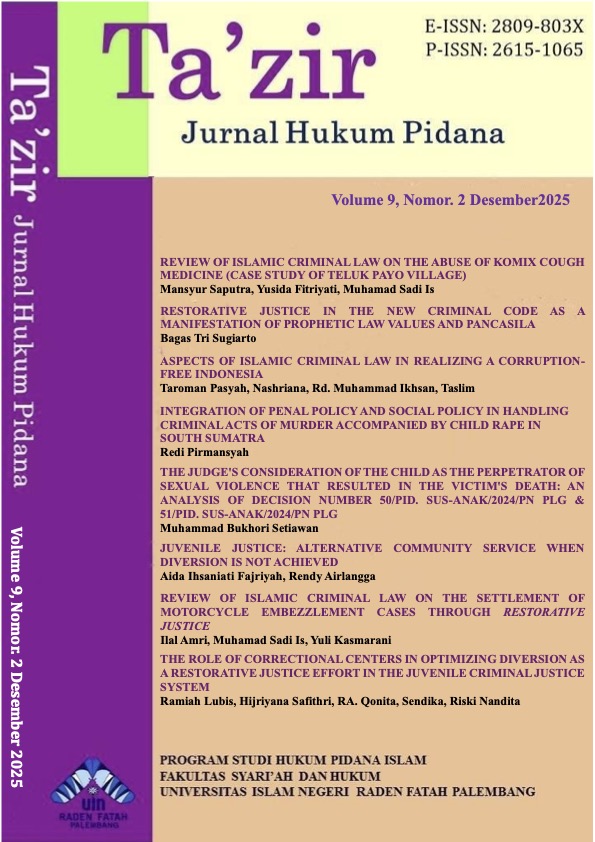
THE ROLE OF CORRECTIONAL CENTERS IN OPTIMIZING DIVERSION AS A RESTORATIVE JUSTICE EFFORT IN THE JUVENILE CRIMINAL JUSTICE SYSTEM
Article Sidebar
Main Article Content
Abstract
This study examines the Optimization of Diversion as a Restorative Justice Effort in the Juvenile Criminal Justice System which is motivated by the importance of child protection as a legal subject that is still in the development stage. The juvenile criminal justice system in Indonesia through Law Number 11 of 2012 concerning the Juvenile Criminal Justice System (SPPA Law) regulates the diversion mechanism as an alternative to resolving cases outside the formal judicial channels. Diversion is expected to prevent children from negative stigma, provide opportunities to improve themselves, and restore relationships between perpetrators, victims, and society through the principle of restorative justice. This type of research uses a normative legal approach complemented by field studies. The data of this research was obtained through literature studies in the form of primary, secondary, and tertiary legal materials, and was complemented by primary data through interviews with law enforcement officials and related parties. The analysis technique used is qualitative analysis with an emphasis on synchronization between legal norms and implementation in the field. The results of the study show that the application of diversion in the juvenile criminal justice system still faces several obstacles, such as limited human resources, lack of public understanding of the concept of restorative justice. However, diversion has been proven to have a strategic function in realizing child protection, preventing labeling effects, and supporting children's social reintegration. Therefore, the optimization of diversion can be carried out through strengthening regulations, increasing the capacity of law enforcement officials, and continuous socialization to the community.
Article Details
Section

This work is licensed under a Creative Commons Attribution-ShareAlike 4.0 International License.
Syarat yang harus dipenuhi oleh Penulis sebagai berikut:
Penulis menyimpan hak cipta dan memberikan jurnal hak penerbitan pertama naskah secara simultan dengan lisensi di bawah Creative Commons Attribution License yang mengizinkan orang lain untuk berbagi pekerjaan dengan sebuah pernyataan kepenulisan pekerjaan dan penerbitan awal di jurnal ini.
Penulis bisa memasukkan ke dalam penyusunan kontraktual tambahan terpisah untuk distribusi non ekslusif versi kaya terbitan jurnal (contoh: mempostingnya ke repositori institusional atau menerbitkannya dalam sebuah buku), dengan pengakuan penerbitan awalnya di jurnal ini.
Penulis diizinkan dan didorong untuk mem-posting karya mereka online (contoh: di repositori institusional atau di website mereka) sebelum dan selama proses penyerahan, karena dapat mengarahkan ke pertukaran produktif, seperti halnya sitiran yang lebih awal dan lebih hebat dari karya yang diterbitkan. (Lihat Efek Akses Terbuka).
How to Cite
References
DAFTAR PUSTAKA
Atmasasmita Romli, Reformasi Hukum, Hak Asasi Manusia Dan Penegakan Hukum (Bandung: Refika Aditama, 2001)
Apong Herlina, Dkk Perlindungan Terhadap Anak Yang Berhadapan Dengan Hukum (Jakarta: PT.Raja Grafindo Persada, 2004),
Badan Penelitian Dan Pengembangan Hukum Dan Hak Asasi and Manusia, Penerapan Restorative Justice Pada Tindak Pidana Anak (Jakarta: Pohon Cahaya, 2016)
Barda Nawawi Arif, Bunga Rampai Kebijakan Hukum Pidana (Jakarta: Prenadamedia Group, 2014)
Djaya I, Memahami Anak Yang Berhadapan Dengan Hukum (Palangkaraya: JDHIN-BOHN, 2020).
Marlina, Peradilan Pidana Anak Di Indonesia: Pengembangan Konsep Diversi Dan Restorative Justice (Bandung: Refika Aditama, 2009).
Muladi, Perlindungan Anak Dalam Sistem Peradilan Pidana (Bandung: Alumni, 2005)
Siti Musaroh, Diversi Dalam Sistem Peradilan Pidana Anak (Yogyakarta: Pustaka Pelajar, 2015).
Soeteddjo Wagiati dan Melani, Hukum Pidana Anak (Bandung: Refika Aditama, 2011)
Undang-Undang No 11 Tahun 2012 Tentang Sistem Peradilan Pidana Anak, n.d.
Agutina Dewi, “Nasib 4 ABH Kasus Pembunuhan Siswi SMP Di Kuburan Cina, Penjara 10 Tahun Hingga ‘Sekolah’ Di LPKS,” last modified 2024, https://www.tribunnews.com/regional/2024/10/11/nasib-4-abh-kasus-pembunuhan-siswi-smp-di-kuburan-cina-penjara-10-tahun-hingga-sekolah-di-lpks.
Ayuningtias Ajeng Dwita, “KPAI Catat 33 Kasus Pelanggaran Hukum Libatkan Anak Di Bawah Umur,” last modified 2024, accessed February 28, 2025, https://goodstats.id/article/kpai-catat-33-kasus-pelanggaran-hukum-libatkan-anak-di-bawah-umur-qgSMA.
Helmi Muhammad Ishar Asep Syaifuddin Hidayat, Samul Anam, “Perlindungan Hukum Terhadap Anak Sebagai Kurir Narkotika,” Jurnal Sosial dan Budaya Syar-i Vol.5 No.3 (2018): 308, https://journal.uinjkt.ac.id/index.php/salam/article/view/10416.
Krisdamarjati Yohanes Advent, “Meningkatnya Kasus Anak Berkonflik Hukum, Alarm Bagi Masyarakat Dan Negara,” Kompas, last modified 2023, https://www.kompas.id/baca/riset/2023/08/28/meningkatnya-kasus-anak-berkonflik-hukum-alarm-bagi-masyarakat-dan-negara