
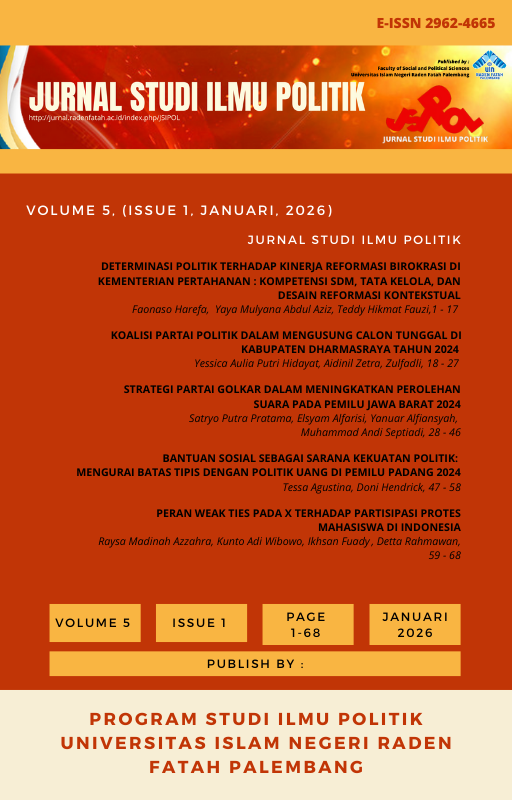
Peran Weak Ties Pada X Terhadap Partisipasi Protes Mahasiswa Di Indonesia
Article Sidebar
Main Article Content
Abstract
This study examines the role of weak ties in social media X in influencing student protest participation in Indonesia. The research focuses on X usage and weak ties in driving both online and offline protest participation. The approach used is a quantitative method with convenience sampling techniques involving Gen Z students who are active users of social media. Data were collected from 126 respondents through disturbing questionnaires with google form using likert scale method. The result produced good validity and reliability (Cronbach’s Alpha > 0.60) and hypothesis testing through path analysis. The key finding reveals X usage has no significant effect on weak ties and does not directly increase protest behavior. Conversely, weak ties significantly influence protest behavior, highlighting the social networks role in engagement.
Downloads
Article Details

This work is licensed under a Creative Commons Attribution-ShareAlike 4.0 International License.
Authors who publish with this journal agree to the following terms:
- Authors retain copyright and grant the journal right of first publication with the work simultaneously licensed under a Creative Commons Attribution License that allows others to share the work with an acknowledgement of the work's authorship and initial publication in this journal.
- Authors are able to enter into separate, additional contractual arrangements for the non-exclusive distribution of the journal's published version of the work (e.g., post it to an institutional repository or publish it in a book), with an acknowledgement of its initial publication in this journal.
- Authors are permitted and encouraged to post their work online (e.g., in institutional repositories or on their website) prior to and during the submission process, as it can lead to productive exchanges, as well as earlier and greater citation of published work
How to Cite
References
Abdullah, K., Jannah, M., & dkk. (2022). Metodologi Penelitian Kuantitatif. Aceh: Yayasan Penerbit Muhammad Zaini.
Barberá, P., Wang, N., Bonneau, R., Jost, J. T., Nagler, J., Tucker, J., & González-Bailón, S. (2015). The critical periphery in the growth of social protests. PLoS ONE, 10(11). https://doi.org/10.1371/journal.pone.0143611
Durotoye, T., Goyanes, M., Berganza, R., & Gil de Zúñiga, H. (2025). Online and Social Media Political Participation: Political Discussion Network Ties and Differential Social Media Platform Effects Over Time. In Social Science Computer Review. SAGE Publications Inc. https://doi.org/10.1177/08944393251332640
Ghozali, I. (2016) Aplikasi Analisis Multivariete Dengan Program IBM SPSS 23. Edisi 8. Semarang: Badan Penerbit Universitas Diponegoro.
Granovetter, M. (1973). “The Strength of Weak Ties”. American Journal of Sociology,, 78(6), 1360 - 1380.
Khondoker, R. (2019). THE ROLE OF SOCIAL MEDIA IN THE POLITICAL PROTEST: THE CASE OF SHAHBAGH MOVEMENT. International Journal of Advanced Research, 7(7), 420–429. https://doi.org/10.21474/IJAR01/9377
Klärner, A., Gamper, M., Keim-Klärner, S., Moor, I., von der Lippe, H., Richter, M., & Vonneilich, N. (2022). Social networks and health inequalities: A new perspective for research. In Social Networks and Health Inequalities: A New Perspective for Research. Springer International Publishing. https://doi.org/10.1007/978-3-030-97722-1
Murthy, D. (2025). Sociology of Twitter/X: Trends, Challenges, and Future Research Directions. 18. https://doi.org/10.1146/annurev-soc-031021
Omotayo, F. O., & Folorunso, M. B. (2020). Use of social media for political participation by youths in Oyo State, Nigeria. eJournal of eDemocracy and Open Government, 12(1), 133–158. https://doi.org/10.29379/jedem.v12i1.585
Ozduzen, O., Aslan Ozgul, B., & Ianosev, B. (2024). ‘Institutions of governance are all corrupted’: anti-political collective identity of anti-lockdown protesters in digital and physical spaces. Social Movement Studies, 23(6), 676–694. https://doi.org/10.1080/14742837.2023.2246920
Scherman, A., & Rivera, S. (2021). Social Media Use and Pathways to Protest Participation: Evidence From the 2019 Chilean Social Outburst. Social Media and Society, 7(4). https://doi.org/10.1177/20563051211059704
Schradie, J. (2018). Moral Monday Is More Than a Hashtag: The Strong Ties of Social Movement Emergence in the Digital Era. Social Media and Society, 4(1). https://doi.org/10.1177/2056305117750719
Simonson, M. D., Block Jr, R., Druckman, J. N., Ognyanova, K., & Lazer, D. M. J. (2024). Black Networks Matter. In Black Networks Matter. Cambridge University Press. https://doi.org/10.1017/9781009415842
Steinert-Threlkeld, Z. C., Mocanu, D., Vespignani, A., & Fowler, J. (2015). Online social networks and offline protest. EPJ Data Science, 4(1), 1–9. https://doi.org/10.1140/epjds/s13688-015-0056-y
Sugiyono. (2018). Metode Penelitian Kuantitatif (1st ed.). Bandung: Alfabeta.
Valenzuela, S., Correa, T., & Gil de Zúñiga, H. (2018). Ties, Likes, and Tweets: Using Strong and Weak Ties to Explain Differences in Protest Participation Across Facebook and Twitter Use. Political Communication, 35(1), 117–134. https://doi.org/10.1080/10584609.2017.1334726