The Influence of Discovery Learning with Nearpod on Science Process Skills and Learning Outcomes
Article Sidebar
Main Article Content
Abstract
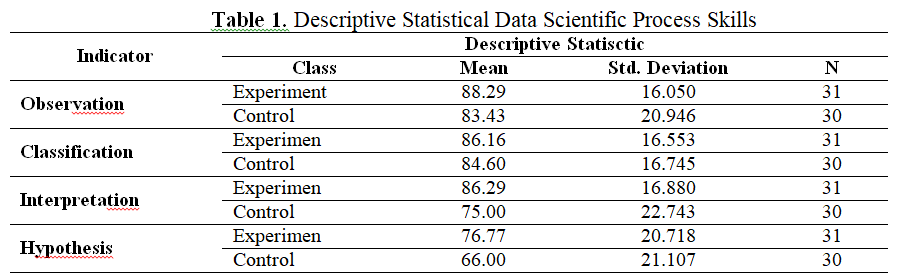
Low science process skills and learning outcomes in digestive system topics stem from non-interactive learning. This study aimed to determine the influence of the Discovery Learning model assisted by Nearpod media on students’ science process skills and learning outcomes in the digestive system topic. A quasi-experimental non-equivalent control group design was used, involving two classes and analyzed via MANOVA/ANCOVA. MANOVA revealed significant influence on observation (0.313) and classification (0.716) indicators. The experimental group’s mean score rose from 60.40 to 83.60, outperfoming the control group (74.00). ANCOVA showed significance of 0.020 (p< 0.05). Nearpod assisted Discovery Learning significantly enhances students science process skills and learning outcomes.
Article Details

This work is licensed under a Creative Commons Attribution-ShareAlike 4.0 International License.
Authors who publish with this journal agree to the following terms:
- Authors retain copyright and grant the journal right of first publication with the work simultaneously licensed under a Creative Commons Attribution-ShareAlike 4.0 International License that allows others to share the work with an acknowledgement of the work's authorship and initial publication in this journal.
-
Authors are able to enter into separate, additional contractual arrangements for the non-exclusive distribution of the journal's published version of the work (e.g., post it to an institutional repository or publish it in a book), with an acknowledgment of its initial publication in this journal.
- Authors are permitted and encouraged to post their work online (e.g., in institutional repositories or on their website) prior to and during the submission process, as it can lead to productive exchanges and earlier and greater citation of published work.

Bio Ilmi: Jurnal Pendidikan by http://jurnal.radenfatah.ac.id/index.php/bioilmi is licensed under a Creative Commons Attribution-ShareAlike 4.0 International License.
How to Cite
References
Almeida, F., & Simoes, J. D. (2019). The role of serious games, gamification, and industry 4.0 tools in education. International Journal of Information and Education Technology, 9(7), 453-457.
Creswell, J. W., & Creswell, J. D. (2018). Research design: Qualitative, quantitative, and mixed methods approaches. Sage.
Cut Tiara. (2024). The implementation of problem-based learning supported by TikTok. Journal of Educational Technology.
Fahaludin, Fauzi, & Purnamasari. (2016). Pembelajaran berbasis proyek dalam praktikum biologi terhadap keterampilan proses sains siswa SMP Muhammadiyah 6 Palembang. Bioilmi: Jurnal Pendidikan, 2(2), 10-22. https://doi.org/10.19109/bioilmi.v2i2
Firdaus, F., Rahmawati, D., & Prasetyo, A. (2019). Penggunaan teknologi pembelajaran dalam meningkatkan hasil belajar biologi. Jurnal Pendidikan Biologi, 45-52.
Garson, G. D. (2012). Testing statistical assumptions. Statistical Associates Publishing.
Hadi, T,. (2022). Pengaruh penggunaan media Nearpod terhadap motivasi dan hasil belajar peserta didik di SMA. Jurnal Teknologi Pendidikan, 45-60.
Hosnan. (2014). Pendekatan saintifik dan kontekstual dalam pembelajaran abad 21. Ghalia Indonesia.
Mulyani, A,. (2020). Pengaruh metode ceramah terhadap hasil belajar sains. Jurnal Pendidikan Sains Indonesia, 8(1), 45-52.
Nugroho, A. (2022). Pengaruh media pembelajaran Nearpod terhadap motivasi belajar peserta didik. Jurnal Teknologi Pendidikan, 15(3), 214-2020.
Priyatno, D. (2014). Descriptive and inferential statistics using SPSS. Mediakom.
Putri, R., & Nugroho, A. (2022). The use of Nearpod to enhance student engagement in biology learning. Journal of Educational Media and Technology, 10(2), 88-96.
Rahmawati, E. (2019). Dampak pembelajaran berbasis hafalan pada minat belajar siswa. Jurnal Psikologi Pendidikan, 5(3), 105-112.
Razali, N. M., & Wah, Y. B. (2011). Power comparisons of Shapiro-Wilk, Kolmogorov-Smirnov, Lilliefors, and Anderson-Darling tests. Journal of Statistical Modeling and Analytics, 2(1), 21-33. https://doi.org/10.2139/ssrn.2148823
Rezky, M,. (2022). Developing science process skills through mobile inquiry. Journal of Biology Education, 11(1), 1-8.
Sari, L., & Yuliana, T. (2021). Students' difficulties in understanding the digestive system. Biology Education Journal, 9(2), 55-62.
Setiawan, H. (2021). Pengaruh media Nearpod terhadap hasil belajar peserta didik pada materi sistem pencernaan. Jurnal Biologi Pendidikan, 17(4), 305-312.
Sudjana, N. (2005). Statistical methods. Tarsito.
Sukardi, I., Wigati, I., & Masripah, I. (2019). Pengaruh metode pembelajaran Discovery Learning terhadap hasil belajar siswa pada mata pelajaran Biologi kelas VII di MTs Patra Mandiri Plaju Palembang. Bioilmi: Jurnal Pendidikan, 6(2). https://doi.org/10.2139/ssrn.2148823
Sukmaningtyas , B., Madang, K., & Suratmi, S. (2018). Pengaruh model pembelajaran kooperatif tipe Jigsaw terhadap berpikir tingkat tinggi (Higher Order Thinking Skills) kelas XI pada materi sistem pencernaan di SMA Negeri 1 Tanjung Raja. Jurnal Pembelajaran Biologi, 5(2), 67-74. https://doi.org/10.2139/ssrn.2148823
Surya, R. (2020). Pengaruh model Discovery Learning berbantuan multimedia terhadap keterampilan proses sains, berpikir tingkat tinggi, dan keterampilan bertanya pada materi sistem pernapasan di SMA Negeri 5 Langsa. Jurnal Biolokus: Jurnal Penelitian Pendidikan Biologi dan Biologi. https://doi.org/10.30821/biolokus.v3i1.671
Tabachnick, B. G., & Fidell, L. S. (2019). Using multivariate statistics (7th ed.). Pearson Education.
Wati, R. (2018). Pengaruh model Discovery Learning terhadap pemahaman konsep sains. Jurnal Pendidikan Sains, 10(2), 123-130.
Wulan, D. (2023). Pengembangan media pembelajaran berbasis Nearpod pada materi keanekaragaman hayati kelas X IPA di SMA/MA. UIN Raden Fatah Palembang.
Wulandari, A. (2022). Pengaruh Nearpod terhadap hasil belajar dan keterlibatan peserta didik dalam pembelajaran biologi. Jurnal Pendidikan Sains Indonesia, 10(1), 12-19.
Yuliana, T., Siregar, D., & Lestari, M. (2023). The integration of Nearpod in biology education: A quasi-experimental study. Technology and Learning Journal, 13(2), 122-130.