Enhancing Students’ Science Process Skills through Local Wisdom Based Biology Worksheets in Ecology and Biodiversity Learning
Bilah Samping Artikel
Isi Artikel Utama
Abstrak
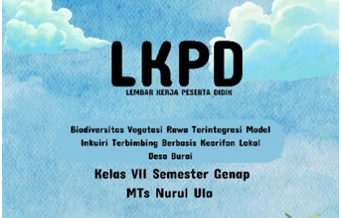
The low relevance of biology subject matter to the local context has resulted in students having limited in-depth understanding of concepts. This research focuses on evaluating the implementation of a Student Worksheet rooted in local wisdom in biology learning, specifically on ecology and biodiversity, through the guided inquiry model. The research employed a descriptive approach at the worksheet implementation stage with seventh-grade students as subjects. Data were obtained from the N-gain score of a written test on. Research data were derived from the N-gain score of a written test on SPS and from the evaluation of worksheet implementation over four meetings. The findings show an N-gain score of 0.51, classified into medium, indicating that the worksheet rooted in local wisdom was able to enhance students’ SPS, foster active engagement, and facilitate concept comprehension. The evaluation results revealed that almost all biology learning activities were implemented, and reflections showed positive responses as the material was relevant to daily life.The worksheet based on local wisdom is feasible to be used as an alternative biology teaching material employing the guided inquiry model at MTs Nurul Ula Desa Burai.
Rincian Artikel

Artikel ini berlisensiCreative Commons Attribution-ShareAlike 4.0 International License.
Authors who publish with this journal agree to the following terms:
- Authors retain copyright and grant the journal right of first publication with the work simultaneously licensed under a Creative Commons Attribution-ShareAlike 4.0 International License that allows others to share the work with an acknowledgement of the work's authorship and initial publication in this journal.
-
Authors are able to enter into separate, additional contractual arrangements for the non-exclusive distribution of the journal's published version of the work (e.g., post it to an institutional repository or publish it in a book), with an acknowledgment of its initial publication in this journal.
- Authors are permitted and encouraged to post their work online (e.g., in institutional repositories or on their website) prior to and during the submission process, as it can lead to productive exchanges and earlier and greater citation of published work.

Bio Ilmi: Jurnal Pendidikan by http://jurnal.radenfatah.ac.id/index.php/bioilmi is licensed under a Creative Commons Attribution-ShareAlike 4.0 International License.
Cara Mengutip
Referensi
Baharom, M. M., Atan, N. A., Rosli, M. S., Yusof, S., & Hamid, M. Z. A. (2020). Integration of Science Learning Apps Based on Inquiry Based Science Education (IBSE) in Enhancing Students Science Process Skills (SPS). International Journal of Interactive Mobile Technologies (Ijim), 14(09): 95-109. https://doi.org/10.3991/ijim.v14i09.11706
Besonia, B. E. A., Espora, S. M. H., Bernardez, M. F. M., & Galagala, M. R. G. (2023). Culturally Relevant Supplemental E-Learning Materials in Teaching Purposive Communication. Tem Journal: 634–639. https://doi.org/10.18421/tem122-06
Bioco, M. S., & Echaure, J. S. (2021). Inquiry-Based Teaching Practices, Attitudes, and Difficulties of Secondary Science Teachers in Masinloc District Division of Zambales for S.Y. 2020-2021. International Journal of Multidisciplinary Applied Business and Education Research, 2(11): 1074–1084. https://doi.org/10.11594/10.11594/ijmaber.02.11.08
Cahyani, G., Enawaty, E., Muharini, R., & Ulfah, M. (2023). Pengembangan Lembar Kerja Peserta Didik (LKPD) Berbasis Kearifan Lokal pada Materi Bioteknologi di SMPN 1 Jagoi Babang. Jurnal Basicedu, 7(5): 3004–3018.
Cahyaningtyas, R., & Desstya, A. (2024). Student’s Science Literacy in Science Learning at Elementary School. Lectura Jurnal Pendidikan, 15(1): 1–14. https://doi.org/10.31849/lectura.v15i1.16068
Cohen, L., Manion, L., & Morrison, K. (2007). Research methods in education (6th ed.). Routledge/Taylor & Francis Group.
Dwi, W., Kuni, E., & Handayawati, U. (2023). Using Contextual Teaching-Learning for Enhance Competency, Student Achievement and Learning Outcome in Developing the Accounting Information System in Indonesia. Rjfa. https://doi.org/10.7176/rjfa/14-6-02
Ernawati, T., & Sujatmika, S. (2021). Development of Worksheet Based on Scientific Approach to Improve Critical Thinking Skills. International Journal of Stem Education for Sustainability, 1(1): 1–10. https://doi.org/10.53889/ijses.v1i1.1
Field, A. (2020). Discovering statistics using IBM SPSS statistics (5th ed.). SAGE Publications.
Gaurifa, M. (2024). Learning Mathematics in Telukdalam Market: Calculating Prices and Money in Local Trade. Afore, 3(2): 97–107. https://doi.org/10.57094/afore.v3i2.2305
Gozalbo, M. E., Zuazagoitia, D., Ruiz‐González, A., Corrochano, D., Soler, A. H., & Ortega, M. T. (2022). Implementing Citizen Science Programmes in the Context of University Gardens to Promote Pre-Service Teachers’ Scientific Literacy: A Study Case on Soil. International Journal of Science Education, 44(10), 1619–1638. https://doi.org/10.1080/09500693.2022.2088877
Haerani, H., Arsyad, M., & Khaeruddin, K. (2023). Development of Experiment-Based Physics Worksheets in Science in Developing Students’ Science Process Skills. Jurnal Penelitian Pendidikan Ipa, 9(1), 292–298. https://doi.org/10.29303/jppipa.v9i1.2609
Hake, R. R., & Reece, J. (1999). Analyzing Change Gain Scores. Retrieved from https://api.semanticscholar.org/CorpusID:141123847
Handayani, S. L. (2021). Comparison of Basic Science Process Skills for Students on Electrical Materials with the Rasch Model Analysis, 7(1): 73–82.
Haryadi, R., & Pujiastuti, H. (2020). The Science Literacy Capabilities Profile Using Guided Inquiry Learning Models. Jurnal Penelitian & Pengembangan Pendidikan Fisika, 6(1): 81–88. https://doi.org/10.21009/1.06109
Hasanah, S., Purwoko, A. A., & Hakim, A. (2020). The Effect of Guided Inquiry Learning Model on Chemistry Learning Outcomes. Journal of Science and Science Education, 1(1): 15–20. https://doi.org/10.29303/jossed.v1i1.446
Hayden, H. E., & Eades-Baird, M. (2020). Disciplinary Literacy and the 4Es: Rigorous and Substantive Responses to Interdisciplinary Standards. Literacy Research Theory Method and Practice, 69(1): 339–357. https://doi.org/10.1177/2381336920937258
Huang, M. C. (2023). Anthropological Dimensions of Modern Educational Culture: Theoretical Analysis. Jcpas, 1(1): 29-42. https://doi.org/10.59652/jcpas.v1i1.58
Jannah, M., Hasni, H., Supriatno, B., & Hamdiyati, Y. (2024). The Use of E-Lkpd Google Slide Assisted Pear Deck to Improve Students Concept Understanding on Ecosystem Material, X(2), 87–98.
Kamaluddin, Firmansyah, E., & Swandi. (2022). Pengaruh Model Inkuiri Terbimbing Terhadap Hasil Belajar Fisika Siswa SMA. Jurnal Lentera Jurnal Lentera, (2): 69–76.
Lakhvich, T. (2021). Public Science Education: Some More Roles and Contributions. Journal of Baltic Science Education, 20(6): 864–867. https://doi.org/10.33225/jbse/21.20.864
Latuny, J. A., Hariani, L. S., & Muzammil, L. (2021). Contextual Learning Method, Learning Facility and Motivation in Relation to Sociology Learning Outcome. 217-224. https://doi.org/10.2991/assehr.k.210715.048
Levine, E. D., & Tamburrino, M. (2024). Culturally Responsive Literature. Journal of Organizational Psychology, 24(2): 10-24. https://doi.org/10.33423/jop.v24i2.7015
Liang, H., Hsu, T., & Hwang, G. (2021). Promoting Children’s Inquiry Performances in Alternate Reality Games: A Mobile Concept Mapping‐based Questioning Approach. British Journal of Educational Technology, 52(5): 2000–2019. https://doi.org/10.1111/bjet.13095
Liu, C., Zowghi, D., Kearney, M., & Bano, M. (2020). Inquiry‐based Mobile Learning in Secondary School Science Education: A Systematic Review. Journal of Computer Assisted Learning, 37(1): 1–23. https://doi.org/10.1111/jcal.12505
Maeng, J. L., Whitworth, B. A., Bell, R. L., & Sterling, D. R. (2020). The Effect of Professional Development on Elementary Science Teachers’ Understanding, Confidence, and Classroom Implementation of Reform‐based Science Instruction. Science Education, 104(2): 326–353. https://doi.org/10.1002/sce.21562
Maryani, U., Bistari, B., Halidjah, S., Kartono, K., dan Pranata, R. (2023). Peningkatan Sikap Ilmiah Siswa Melalui Model Inkuiri Terbimbing Pada Materi FPB dan KPK Kelas IV Di Sekolah Dasar Negeri 34 Pontianak Selatan. As-Sabiqun, 5(3), 475–491. https://doi.org/https://doi.org/10.36088/assabiqun.v5i2.3005
Matsna, F., Rokhimawan, M., dan Rahmawan, S. (2023). Analisis Keterampilan Proses Sains Siswa Melalui Pembelajaran Berbasis Praktikum Pada Materi Titrasi Asam-Basa Kelas XI SMA/MA. Dalton Jurnal Pendidikan Kimia Dan Ilmu Kimia, 06(01): 21–28. https://doi.org/https://doi.org/10.31602/dl.v6i1.9187
Nahm, F. S. (2016). Nonparametric statistical tests for the continuous data: the basic concept and the practical use. Korean Journal of Anesthesiology, 69(1), 8–14.
Nisa, A. F., & Utaminingsih, R. (2020). Pengembangan Lembar Kegiatan Peserta Lidik IPA berbasis Pendekatan Kontekstual Kelas V Sekolah Dasar. Trihayu Jurnal Pendidikan Ke-SD-An, 6(3): 874-880. https://doi.org/https://doi.org/10.30738/trihayu.v6i3.8146
Nuayi, A. ., & Very. (2020). Implementasi Model Pembelajaran Guided Inquiri untu Meningkatkan Keterampilan Proses Sains dan Hasil Pengetahuan Kognitif Siswa, 1(2): 1–9.
Oktavia, S. W., Astalini, & Kurniawan, D. A. (2024). Identifikasi Keterampilan Proses Sains Peserta Didik Kelas XI Pada Materi Dinamika Gerak Lurus. Edu-Sains Volume, 13(1): 19-25. Retrieved from https://doi.org/10.22437/jmpmipa.v13i1.29751
Pela, S. O., Le, N. N., Kaboro, P. G., & Nurjamil, A. (2023). Innovation of Physics E-Module: Utilizing Local Wisdom of Lampung’s Handwritten Batik in Teaching Heat and Temperature Material to Foster Students’ Scientific Attitude. Sch. Jo. Phs. Ed, 4(4): 132–138. https://doi.org/10.37251/sjpe.v4i4.924
Pradana, A., Rahayu, S., & Rusdi, R. (2021). Development of guided inquiry-based worksheets to improve science process skills. Journal of Physics: Conference Series, 17(1): 73-88. https://doi.org/. https://doi.org/10.1088/1742-6596/1796/1/012078
Putri, N., Mulyani, S., & Priyambodo, E. (2022). Pengembangan LKPD berbasis inkuiri terbimbing untuk meningkatkan keterampilan proses sains pada materi koloid. Jurnal Inovasi Pendidikan Kimia, 16(1): 1–10. https://doi.org/https://doi.org/10.15294/jipk.v16i1.53289
Rahmah, N., Subhan, S., Nursyamsi, N., Fitriani, F., & Nurliana, N. (2024). Contextual-Based Development of Early Children’s Learning in the Era of the Industrial Revolution 4.0. Jurnal Syntax Transformation, 5(6): 835–843. https://doi.org/10.46799/jst.v5i6.958
Rohandi, R. (2022). Pre-Service Science Teachers’ Competence and Confidence in Scientific Inquiry. International Journal of Applied Sciences and Smart Technologies, 4(2): 267–280. https://doi.org/10.24071/ijasst.v4i2.5428
Safitri, D., Nurdiyanti, N., & Fadhillah, N. (2018). Motivasi Dan Hasil Belajar Kognitif Siswa Melalui Model Pembelajaran Inkuiri Terbimbing. Biosel: Biology Science and Education, 7(2): 106-113. https://doi.org/10.33477/bs.v7i2.648
Safitri, M., Halendra, Selaras, G. H., & Sumarmin, R. (2019). Praktikalitas LKPD Eksperimen Biologi Berorientasi Keterampilan Proses Sains untuk Peserta Didik SMA Kelas XI Semester 1. Biolomi, 5(2): 106–113.
Salchegger, S., Wallner-Paschon, C., & Bertsch, C. (2021). Explaining Waldorf Students’ High Motivation but Moderate Achievement in Science: Is Inquiry-Based Science Education the Key? Large-Scale Assessments in Education, 9(1): 1-23. https://doi.org/10.1186/s40536-021-00107-3
Sari, P., Kurniawati, R., & Santoso, D. (2021). Pengaruh penggunaan LKPD berbasis inkuiri terbimbing terhadap keterampilan proses sains siswa pada materi hukum Hooke. Jurnal Penelitian Pendidikan Fisika, 6(2): 122–131. https://doi.org/https://doi.org/10.26740/jppf.v6n2.p122-131
Sartika, D., Fitria, N., & Hamid, H. (2020). Penerapan model pembelajaran inkuiri terbimbing terhadap keterampilan proses sains siswa pada materi senyawa karbon. Jurnal Pendidikan Biologi, 9(2): 45–53. https://doi.org/https://doi.org/10.20527/bioed.v9i2.8274
Seneviratne, D. V. K. P., Khatibi, A., & Azam, S. M. F. (2020). Changes in Practicing Teachers’ Self Efficacy in Teaching Scientific Inquiry. Management Studies, 8(4): 307-314. https://doi.org/10.17265/2328-2185/2020.04.004
Setianingrum, D. A., Ula, E. M., Pratiwi, S., & Jumadi, J. (2022). Development of LKPD With a Contextual Approach Based on Flipbook to Increase Science Learning Motivation. Jurnal Pendidikan Sains Indonesia, 10(4): 833–848. https://doi.org/10.24815/jpsi.v10i4.26098
Sheskin, D. J. (2003). Parametric and non parametric statistical procedures: Third edition. Handbook of Parametric and Nonparametric Statistical Procedures: Third Edition, 1–1193.
Tapio, R. P. (2025). The Role of Data Assumptions in Selecting Between Parametric and Nonparametric Tests, 27(11), 127–135.
Toma, R. B. (2021). Effect of Confirmation and Structured Inquiry on Attitudes Toward School Science. School Science and Mathematics, 122(1): 16–23. https://doi.org/10.1111/ssm.12505
Uji, R., Angga, D., & Rajagukguk, W. (2022). Differences in Students’ Mathematical Communication Ability and Self-Efficacy Between Open Ended and Contextual Learning Approach. JEP. 13(7):19-25 https://doi.org/10.7176/jep/13-7-03
Warnida, Y., Zaini, M., & Suyidno, S. (2023). Feasibility of Student Worksheets Based on Critical Thinking Skills on the Topic of Heat and Temperature. Jurnal Ilmiah Pendidikan Fisika, 7(1): 110-119. https://doi.org/10.20527/jipf.v7i1.7496
Wedaswari, N. M. N., & Tegeh, I. M. (2023). Science Learning Videos Based on Contextual Approaches for Grade v Elementary Schools. International Journal of Elementary Education, 7(3): 524–534. https://doi.org/10.23887/ijee.v7i3.61768
Widiya, A. W., & Radia, E. H. (2023). Pengaruh Model Pembelajaran Inkuiri Terbimbing Terhadap Kemampuan Berpikir Kritis dan Hasil Belajar IPS. Aulad: Journal on Early Childhood, 6(2): 127–136. https://doi.org/10.31004/aulad.v6i2.477
Winarno, N., Rusdiana, D., Samsudin, A., Susilowati, E., Ahmad, N. J., & Afifah, R. M. A. (2020). Synthesizing Results From Empirical Research on Engineering Design Process in Science Education: A Systematic Literature Review. Eurasia Journal of Mathematics Science and Technology Education, 16(12): 1-18. https://doi.org/10.29333/ejmste/9129
Winarti, W., & Sari, M. P. (2020). Escalation in Students’ Science Process Skills on Chapter Wave Vibration and Sound Through Guided Inquiry Learning Model. Journal of Teaching and Learning Physics, 5(2): 70–79. https://doi.org/10.15575/jotalp.v5i2.8613
Wiradika, I. N. I., & Retnawati, H. (2021). Contextual Learning in Elementary School: A Meta Analysis. Progres Pendidikan, 2(3), 174–182. https://doi.org/10.29303/prospek.v2i3.187
Zainudin, M., Putri, S. D. A., & Qurrotaa’yun, L. (2023). Peningkatan Keterampilan Menulis Artikel Ilmiah dengan Menggunakan Metode Inkuiri Terbimbing pada Mahasiswa S-1 Keperawatan. Jurnal Pendidikan Dan Konseling (JPDK), 5(4): 62–71. https://doi.org/10.31004/jpdk.v5i4.16785