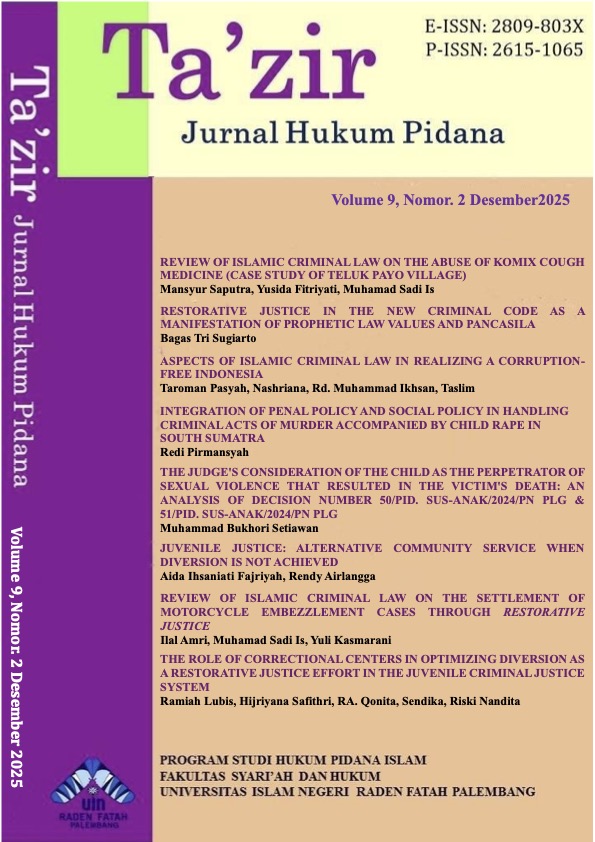
INTEGRATION OF PENAL POLICY AND SOCIAL POLICY IN HANDLING CRIMINAL ACTS OF MURDER ACCOMPANIED BY CHILD RAPE IN SOUTH SUMATRA
Bilah Samping Artikel
Isi Artikel Utama
Abstrak
This study examines the implementation of law enforcement against perpetrators of murder accompanied by child rape in the jurisdiction of the South Sumatra Regional Police, using a criminological approach. The main focus is on evaluating the effectiveness of law enforcement, identifying structural and cultural barriers, and applying criminological theories such as Strain, Differential Association, and Routine Activity. The methodology used is an empirical juridical approach with qualitative methods. The findings show that the law enforcement process has been in accordance with positive law provisions, but still faces challenges in the form of limited human resources, lack of coordination between institutions, and the influence of socio-cultural factors. Criminological analysis reveals that these crimes are triggered by social pressure, weak moral control, and open opportunities for crime due to minimal supervision. Therefore, integration between criminal law and social policies is needed in formulating law enforcement strategies for serious crimes involving children as victims
Rincian Artikel

Artikel ini berlisensiCreative Commons Attribution-ShareAlike 4.0 International License.
Syarat yang harus dipenuhi oleh Penulis sebagai berikut:
Penulis menyimpan hak cipta dan memberikan jurnal hak penerbitan pertama naskah secara simultan dengan lisensi di bawah Creative Commons Attribution License yang mengizinkan orang lain untuk berbagi pekerjaan dengan sebuah pernyataan kepenulisan pekerjaan dan penerbitan awal di jurnal ini.
Penulis bisa memasukkan ke dalam penyusunan kontraktual tambahan terpisah untuk distribusi non ekslusif versi kaya terbitan jurnal (contoh: mempostingnya ke repositori institusional atau menerbitkannya dalam sebuah buku), dengan pengakuan penerbitan awalnya di jurnal ini.
Penulis diizinkan dan didorong untuk mem-posting karya mereka online (contoh: di repositori institusional atau di website mereka) sebelum dan selama proses penyerahan, karena dapat mengarahkan ke pertukaran produktif, seperti halnya sitiran yang lebih awal dan lebih hebat dari karya yang diterbitkan. (Lihat Efek Akses Terbuka).
Cara Mengutip
Referensi
Arief, B. N. (2010). Problems of Law Enforcement and Criminal Law Policy. Jakarta: Kencana.
Cohen, L. E., & Felson, M. (1979). Social Change and Crime Rate Trends: A Routine Activity Approach. American Sociological Review, 44(4), 588–608.
Damaiana, & Tonny Saputri, M. A. S. (2022). Criminological Analysis of Sexual Abuse and Violence against Children. Recidive, Sebelas Maret University.
Jemmi, Madiong, B., & Zubaidah, S. (2023). Analysis of the Application of Differential Association Theory in Sexual Violence Crimes in Mamasa Regency. Clavia: Journal of Law.
Merton, R. K. (1938). Social Structure and Anomie. American Sociological Review, 3(5), 672–682.
Mustafa, A. B. A., et al. (2023). Analyzing the Criminological and Victimological Perspectives of the Attempted Rape and Murder Case in Kutai. Jurnal Intelektiva.
Rumiyati, R. (2021). Legal Protection for Children as Victims of Rape by Children. IPMHI Law Journal.
Soekanto, S. (2008). Factors Affecting Law Enforcement. Jakarta: Raja Grafindo Persada.
Sutherland, E. H., & Cressey, D. R. (1978). Principles of Criminology. Philadelphia: Lippincott.
Linzy Maylika Husna & Hudi Yusuf. (2025). A Criminological Analysis of Child-by-Child Murder from the Perspective of Social Control Theory (Case Study of the Murder and Rape of a Junior High School Student in Palembang). Jurnal Intelek Insan Cendikia
Holipah, Asmawati . (2022). Analysis of Policies on the Protection of Children from Violence in the City of Palembang. Responsive: Journal of Thought and Research in Administration, Social Sciences, Humanities and Public Policy,
Yuriah, S., Ananti, Y., & Nurjayanti, D. (2024). Dynamics of the experience of sexual violence and its impact on girls in Ogan Komering Ulu Regency. International journal of health sciences. https://doi.org/10.53730/ijhs.v8ns1.14860.
Saefudin, Y., Anugrahing, G., Rizky, S., & Khoirun, N. (2025). Criminological Analysis of Child Sexual Violence in the Family: An Indonesian Case Study Based on Routine Activity Theory. Kosmik Hukum. https://doi.org/10.30595/kosmikhukum.v25i2.27014.
Shekuwe, R. (2025). Community Knowledge and Perceptions of Child Sexual Abuse in Arusha District, Tanzania: Implications for Policy and Practice. Asian Journal of Education and Social Studies. https://doi.org/10.9734/ ajess/2025/v51i61996