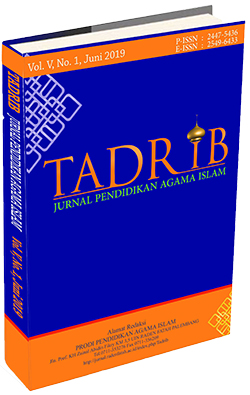
Collaboration Between Parents and Teachers in the Formation of Students' Religious Character Through Islamic Religious Education Learning in the Era of Digitalization: A Case Study at SDIT
DOI:
https://doi.org/10.19109/tadrib.v11i2.31951Keywords:
Religious character; , parent–teacher collaboration; , Islamic Religious Education;Abstract
This study explores the collaborative model between teachers and parents in shaping the religious character of elementary school students in the digitalization era. The research is situated within the broader discussion of character education, which emphasizes the integration of moral values, religious practice, and family–school partnership. The purpose of this study is to examine the forms, processes, and effectiveness of collaboration between teachers and parents in strengthening students’ religious character through Islamic Religious Education (PAI) learning at SDIT Al-Maadin. Using a qualitative descriptive approach, data were collected through interviews, observations, and documentation, and analyzed using the Miles and Huberman interactive model. The findings reveal that teachers play a central role as moral role models (uswah hasanah) by integrating religious values into daily learning activities, establishing routines of prayer, Qur’an recitation, and moral habituation. Parents, on the other hand, act as partners who reinforce school-based religious practices at home through monitoring, guidance, and communication facilitated by the student handbook and WhatsApp groups. The study shows that digitalization does not require sophisticated technological tools; instead, it highlights the strategic use of simple digital communication to strengthen family–school synergy. Collaboration between teachers and parents results in the development of students’ religious character across three domains: aqidah–ibadah, moral conduct, and social values. The study concludes that consistent coordination and shared responsibility between school and family significantly enhance students’ religious character, though challenges remain in ensuring consistent home practices amid varied parenting patterns and digital distractions. Future research may examine comparative models across different school settings or explore parental digital literacy in greater depth
Downloads
References
Alonazi, W. B. (2023). Parent--teacher communication and its impact on students’ character development in the digital age. International Journal of Instruction, 16(2), 45–62.
Bandura, A. (1986). Social foundations of thought and action: A social cognitive theory. Englewood Cliffs: Prentice-Hall.
Cahyanto, A. (2023). The role of the family in habituating students' religious values in the digital era. Journal of Character Education, 13(2), 145–160.
Dordia, R., Arifin, M., & Sulastri, D. (2025). Challenges of supervising the use of gadgets in elementary school age children. Journal of Educational Technology, 18(1), 22–35.
Epstein, J. (2018). School, Family, and Community Partnerships: Preparing Educators and Improving Schools. Journal of Education Research, 111(3), 310–315.
Febriyanti, R., & Khofifah, N. (2023). The effectiveness of worship habituation in increasing the religiosity of elementary school children. Journal of Tarbiyah Islamiyah, 7(1), 25–36.
Feagans, L., & Farran, D. (2020). Digital exposure and cognitive development in early childhood. Child Development Review, 4(2), 145–159.
Ginting, R., Siregar, A., & Munawwarah, S. (2024). The use of digital media in PAI learning in elementary school. Journal of Islamic Education, 9(2), 200–213.
Himmah, L., & Fitriani, N. (2023). Challenges for parents in supervising the use of gadgets in children. Journal of Early Childhood Education, 12(1), 88–101.
Himmah, L., & Fitriani, N. (2024). The influence of parental parenting on the religiosity of elementary school children. Journal of Educational Psychology, 8(1), 67–80.
Kartika, L., Hasanah, N., & Ramadhan, R. (2023). The implementation of religious habituation in elementary schools as the formation of student character. Journal of Basic Education of the Archipelago, 5(1), 55–66.
Kohlberg, L. (1984). The psychology of moral development. Harper & Row.
Lickona, T. (1997). The teacher’s role in character education. Journal of Education, 179(2), 39–52.
Lumpkin, A. (2008). Teachers as role models: Teaching character and moral virtues. Journal of Physical Education, Recreation & Dance, 79(2), 45–49.
Maulidi, A., & Badriyah, F. (2024). Integration of digital media in Islamic religious education learning. Journal of Islamic Educational Technology, 11(1), 12–24.
Miles, M. B., & Huberman, A. M. (1994). Qualitative data analysis: An expanded sourcebook. SAGE Publications.
Nurizah, S., Salimah, S., & Rahmawati, R. (2024). Habituation of worship and its impact on the religious character of students. Journal of Islamic Education Studies, 9(1), 77–90.
Wenger, E. (1998). Communities of practice: Learning, meaning, and identity. Cambridge University Press.
Hidayat, R., & Khalika, N. N. (2019). Business and Controversy of the Indonesia Movement Without Dating. Retrieved October 17, 2019, from tirto.id website:
https://tirto.id/bisnis-dan-kontroversi-gerakan-indonesia-tanpa-pacaran-cK25
Al-Ghazali. (2005). Ihya’ Ulumuddin. Beirut: Dar al-Kutub al-Ilmiyyah. (As cited in your discussion on classical Islamic education)
Bronfenbrenner, U. (1992). Ecological systems theory. London: Jessica Kingsley.
Ibn Qayyim, A. (2005). Madarij as-Salikin. Riyadh: Dar al-Salam.
Kamba, M. N. (2018). Today's Kids Reinvent Islam. South Tangerang: IIMaN Library.
Madjid, N. (2002). Modern Man Yearns for Allah: A Reflection on Positive Sufism. Jakarta: IIMaN & Hikmah.
Miskawaih, I. (1998). Tahdzib al-Akhlaq. Beirut: Dar al-Kutub al-Ilmiyyah.
Piaget, J. (1965). The moral judgment of the child. Free Press.
Sidiq, U., & Choiri, M. (2019). Qualitative Research Methods in the Field of Education. Source: CV. Nata Karya.
Sallam, M., & Al-Ali, S. (2022). School--home collaboration in character education: Perspectives from Islamic schools. International Journal of Educational Development, 9(1), 102623.
Ikhwan, M. (2019). Ulama and Public Islamic Conservatism in Bandung: Islam, Identity Politics, and the Challenge of Horizontal Relations. In I. Burdah, N. Kailani, & M. Ikhwan (Eds.), Ulama, Politics, and National Narrative. Yogyakarta: PusPIDeP.
Halstead, J. M., & Taylor, M. J. (2000). Learning and teaching about values in schools. In M. Leicester, S. Modgil & C. Modgil (Eds.), Education, Culture and Values (Vol. 1, pp. 3–16). London: Falmer Press.
Livingstone, S., & Helsper, E. (2008). Parental mediation of children’s internet use. In J. Bryce & D. Johnson (Eds.), Digital Childhoods. London: Springer.
Lomibao, L. S. (2023). Digital communication and parental involvement in primary education: Opportunities and challenges. Education and Information Technologies, 2(1), 14567–14584.